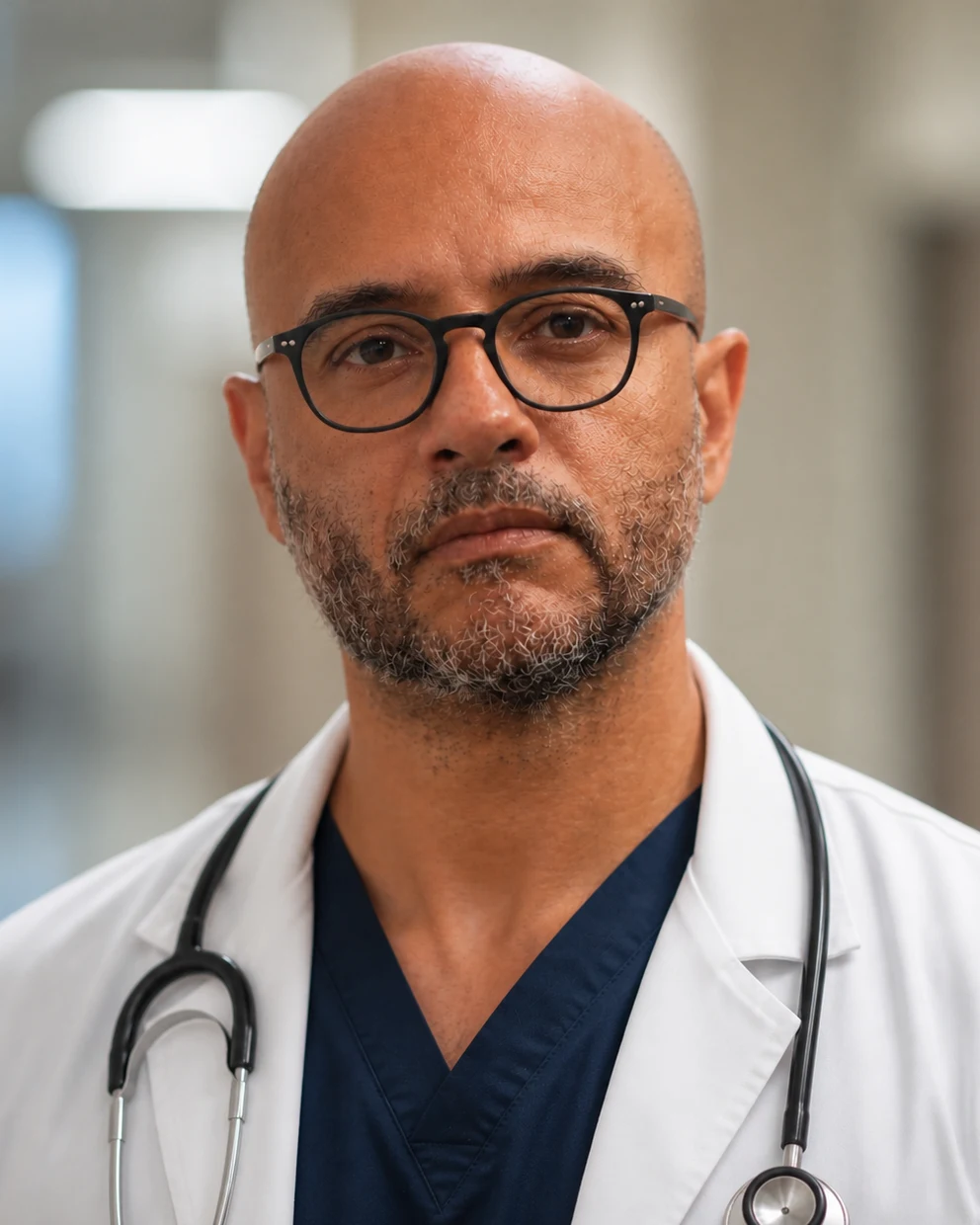
What I actually do
Since 2014 I have been adjunct faculty in the Biology department at Miami Dade College, teaching BSC2085 and BSC2086 — Anatomy and Physiology I and II — face to face, online, and hybrid. Cell microscopy, cell physiology and structure, organ function integrated with systemic physiology.
Since 2023 I have worked on contract at the M.A.R.C. Institute in Doral, performing bespoke gross anatomical human dissections and pathophysiologic instruction for practising healthcare professionals. Until 2025 I taught the same material to physician assistant students at South University.
In a dissection lab you correlate structure with function, and then you integrate the pathology — because every donor on every table arrived there by way of something. The etiology is the lesson. That is not a morbid observation. It is the reason anatomy is worth learning properly rather than memorising.
It started as a job at the tutoring desk
In 1994 I was an undergraduate tutoring maths and science at Miami Dade College's study centre. I designed and supervised the Anatomy and Physiology open lab, and on short notice I would substitute for professors teaching pre-college algebra.
From 1996 to 2000 I worked as an academic advisor in the college's New Student Center — auditing transcripts, mapping upper-division transfer requirements, processing graduation approvals. Unglamorous work. It is also where I learned that most people who do not make it are not stopped by ability. They are stopped by a requirement nobody explained to them in time.
Since then: high school science at Miami Coral Park, chemistry and head of the science department at a charter school in Coconut Grove, STEM instruction at Miami Country Day, weekend test prep for students nobody else was prepping. Medical school teaching in St. Kitts. And in 2003, a pre-matriculation programme at UMDNJ's School of Osteopathic Medicine, where I taught medical terminology, gross anatomy and histology to students about to start their first year.
I have been preparing people for medicine for as long as I have been teaching it.
I went to medical school twice and finished neither time
I hold a Master of Science in Biomedical Sciences from UMDNJ's Graduate School of Biomedical Sciences. I completed a year and a half of four at UMDNJ's School of Osteopathic Medicine, and two years of four at the University of Medicine and Health Sciences in St. Kitts. I sat for USMLE Step 1. I finished neither degree — what I hold is basic science medical training, and I describe it that way because that is what it is.
I could leave that off a website. Most people would. I am including it because it is the single most useful thing I know that a consultant with a clean record cannot tell you: I know what the attrition path actually looks like from the inside. I know what the semester feels like before it goes wrong, and what the advice sounds like when it is too general to help.
If you are a student who is struggling, you are not talking to someone who found it easy.
The students nobody was advising
From 1997 to 2000 I served as Chairman of Minority Affairs for Florida International University's chapter of the American Medical Student Association. The work was unglamorous and specific: finding research opportunities and MCAT summer programmes that under-represented students qualified for, and making sure they actually heard about them before the deadlines closed.
I had been through those programmes myself — the Minority Medical Education Program's summer science enrichment in Chicago, the University of Miami's health careers motivation programme. I was a National Medical Fellowship Scholar in 2002.
Three decades later I am still doing a version of that job. The information gap is the thing that decides outcomes, and it has never been evenly distributed.
Empathy and rigor, in that order
My teaching philosophy combines empathy and rigor to prepare students for healthcare careers. I create structured, inclusive learning environments that emphasise accountability, applied learning, and technology integration. Through active strategies such as clinical case studies and hands-on labs — including organ dissections, EKG interpretation, and spirometry — I bridge theory with practice. With over two decades of teaching experience and advanced training in medicine and biomedical sciences, I aim to cultivate competent, compassionate professionals and lifelong learners.
In practice that means my instruction maps to the six ARC-PA competency domains that physician assistant programmes are audited against — medical knowledge, patient care preparation, professionalism, interpersonal and communication skills, practice-based learning and improvement, and systems-based practice. Assessment drives remediation, and progression data drives the assessment.
I am credentialed as an eligible instructor through SACSCOC and the Higher Learning Commission, and I am a member of the American Association of Anatomists and the American Physiological Society. I teach in English and Spanish; both are native languages for me, and in Miami that is not a footnote.
Two other things I do
Medical school advising. Three decades of pipeline work, and I teach the courses that gate the whole path. If you are considering it, applying, or already enrolled and struggling — that is the room I have spent my career in.
The lab. An innovation, research and development lab working across technology, science, and medical engineering. Thirty-one years of teaching how the body compensates before it fails is what makes the measurement gaps visible to me.
Assessment design. Accreditation-aligned assessment and remediation systems for physician assistant and health-professions programmes.